Starward Observatory

Astronomy news

Featured

NASA

Webb helps trace a stellar merger in Andromeda

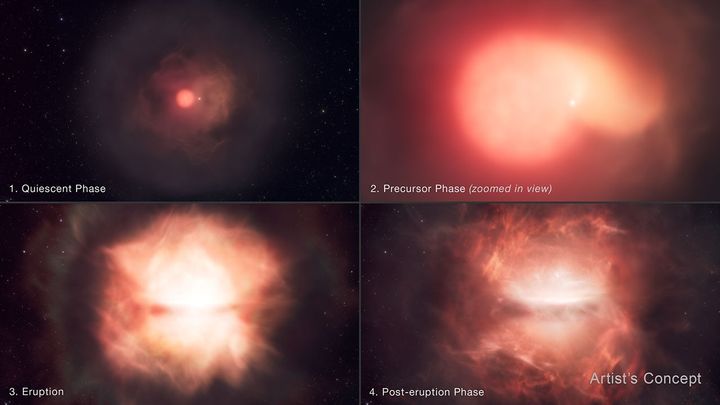
After a star spiralled into its supergiant companion, Webb observed the aftermath in infrared. Combined with earlier observations, the data let astronomers follow the system from before the 2025 eruption to the expanding dust left by the merger.

Starward perspective

The most valuable part of this result is the timeline. With observations before the eruption, researchers can ask whether the star’s earlier brightening offers a clue for spotting future mergers.
Read the NASA release
Artist’s concept showing two stars before, during and after their merger in four panels.

Mission replays

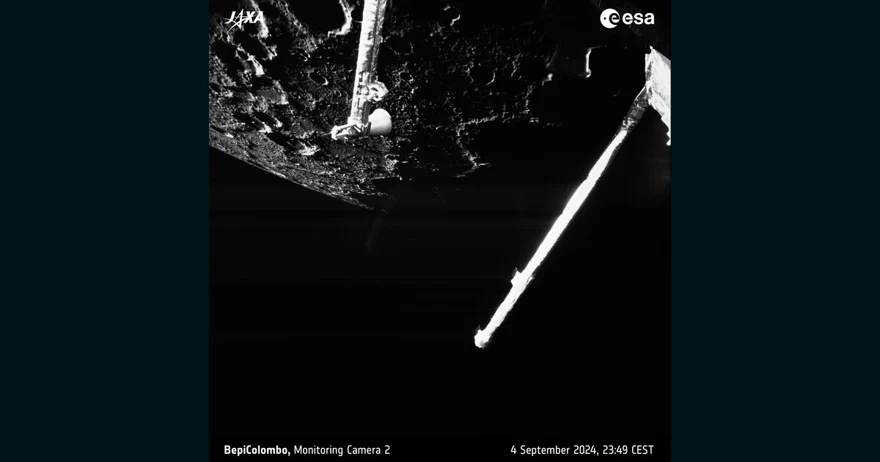
Mercury’s cratered surface photographed by BepiColombo during its 2024 flyby.
Mercury flyby, 2024 · ESA/BepiColombo/MTM

ESA Operations

BepiColombo reaches Mercury orbit

ESA confirmed that the joint European–Japanese mission was captured into orbit around Mercury on 21 November. A software issue cut the engine burn short. The spacecraft is safe, and the flight team is investigating.

Starward perspective

Compare the path beside Mercury with the ESA mission update. The simulation shows where the planned burn was meant to put the spacecraft; the actual burn ended early. That difference is what makes the next orbit update worth watching.

View in Starward Observatory Read the ESA mission update

ESA planned trajectory · 21 Nov 2026, 19:01 UTC

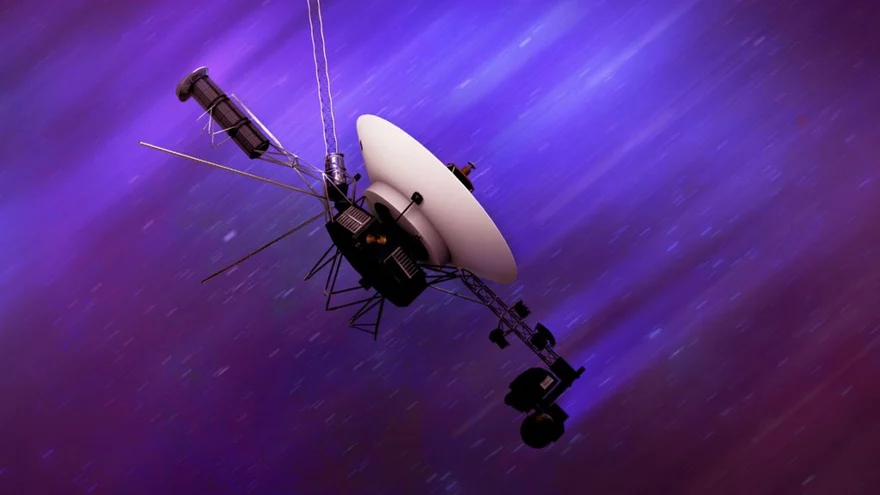
Artist’s concept of the Voyager spacecraft in interstellar space.

NASA

Voyager 1 reaches one light-day from Earth

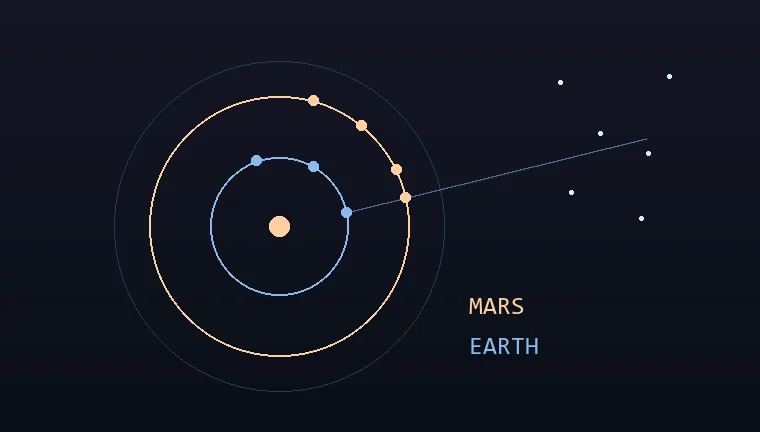
Voyager 1 passed the milestone on 18 November, about 26 billion kilometres from Earth. A radio signal takes roughly 24 hours to travel each way, so a command and its reply take about two days in transit.

Starward perspective

The delay changes how a mission team can respond to a fault. By the time engineers see a status report, it describes what the spacecraft was doing a day earlier. Each test command and its confirmation takes another round trip, so a diagnosis has to be built one exchange at a time.

View in Starward Observatory Read the NASA release

Predicted position at the NASA milestone · 18 Nov 2026, 10:16:07 UTC

Observing guides

Astronomy guides

Astrology

News archive

ESA

ESA selects a seven-spacecraft mission to study plasma

ESA member states have selected Plasma Observatory as the agency’s next medium-class science mission. Seven spacecraft will work together to measure particles and electromagnetic fields as the solar wind interacts with Earth’s magnetic environment. Taking measurements on several scales at once will help scientists follow how energy moves through that system.

Read the ESA release

NASA

Stratospheric dust holds clues to ice beyond Neptune

Researchers examined 12 dust grains collected high above Earth. Minerals in the grains carry a signature consistent with ancient water rich in heavier oxygen isotopes, offering clues to the ice that once existed in the Kuiper Belt.

Read the NASA report

ESA

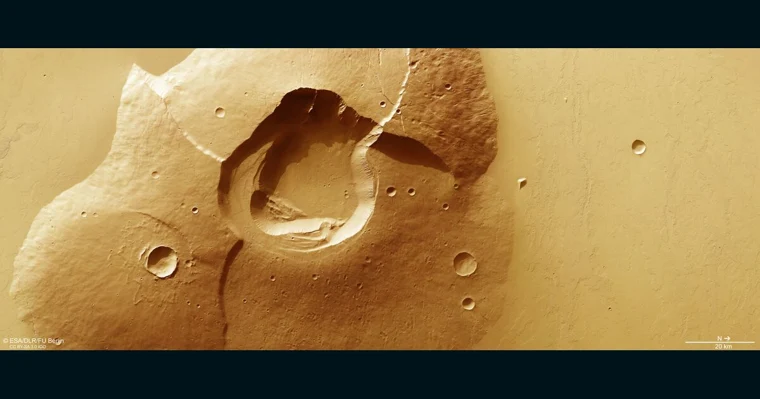
Mars Express images reveal two collapses at a Martian volcano

ESA’s Mars Express released a new view of Tharsis Tholus, an approximately eight-kilometre-high volcano on Mars. Images from its High Resolution Stereo Camera show an older outer caldera and a younger inner one. The nested depressions preserve evidence of at least two collapses, helping researchers piece together how the volcano’s summit changed over time.

Starward perspective

Look for the rims of the two depressions. Where the younger rim cuts across the older one, the landscape itself tells you which collapse came later.

Read the ESA release
Perspective of Tharsis Tholus on Mars, showing the summit depressions.
Tharsis Tholus · ESA/DLR/FU Berlin

ESA

Euclid releases the foundation for its 3D map

Euclid’s first major data release covers more than a billion objects and draws on about 13 months of observations. It gives researchers a starting point for charting the large-scale structure of the universe.

Read the ESA release

NSF NOIRLab

Two Chilean telescopes capture a nearby supernova brightening

The Dark Energy Camera and Gemini South imaged SN 2026ahvu while it was still brightening in the barred spiral galaxy NGC 1433. ATLAS first detected the object on 2 November, and spectroscopy identified it as a young Type Ia supernova. The new observations give astronomers a chance to study the early rise before peak brightness.

Read the NSF NOIRLab release

NSF NOIRLab

Webb and Gemini find a candidate quasar pair at cosmic dawn

Spectra from Webb and Gemini North show two quasar-like sources as they appeared 900 million years after the Big Bang. The spectra favour two actively feeding black holes, though gravitational lensing could still explain both images. If the pair is confirmed, it could help test how massive black holes grew so early.

Starward perspective

The next test is whether one lens model can reproduce the two images. That matters more than the record for distance, because it could change the interpretation from one feeding black hole to two.

Read the NSF NOIRLab release

STScI

Hubble traces missing oxygen in dwarf galaxies

A study of 37 nearby dwarf galaxies found that they retain only a small share of the oxygen their stars produced. Winds driven by massive stars and supernovae may have carried much of it beyond the galaxies.

Read the STScI release

Research paper

Rubin spots two asteroids trailing Neptune

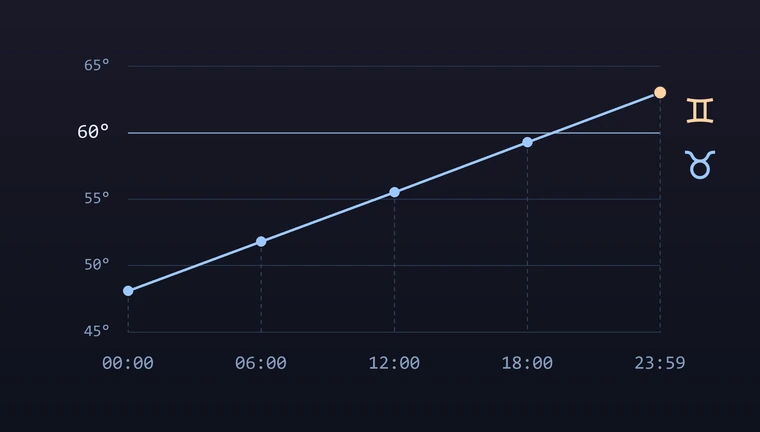
Observations from the Vera C. Rubin Observatory revealed two asteroids in stable orbits roughly 60° behind Neptune along its path around the Sun. The finds double the number of confirmed long-term members of that group from two to four.

Read the paper on arXiv

ESO

Two debris rings circle a white dwarf

Observations from ESO’s Very Large Telescope reveal two rings separated by a gap around the white dwarf J1328−1450. The research team proposes that surviving planetary bodies could account for the gap.

Read the ESO release

NSF NOIRLab

Rubin spots a possible dwarf planet beyond Pluto

Rubin Observatory detected 2026 ED138 at a distance beyond Pluto’s orbit. The team combined repeated Rubin detections with archival images to trace its path. The Minor Planet Center published the observations, while the object’s dwarf-planet status remains uncertain.

Starward perspective

Brightness can flag a body worth following. It is a poor shortcut to its size, because a smaller reflective surface can also be bright. Look for measurements that constrain size before treating the classification as settled.

Read the NSF NOIRLab release

NSF NOIRLab

Gemini resolves chains of knots in supernova remnant Pa 30

New Gemini North images show that the radial filaments in Pa 30 are chains of compact knots rather than smooth streaks. The observations used the Gemini Multi-Object Spectrograph. Pa 30 is considered the likely remnant of a supernova seen in 1181; the finer structure gives researchers a new way to examine how the ejecta evolved.

Read the NSF NOIRLab release

ESO

A fast star offers a new way to probe the Milky Way’s black hole

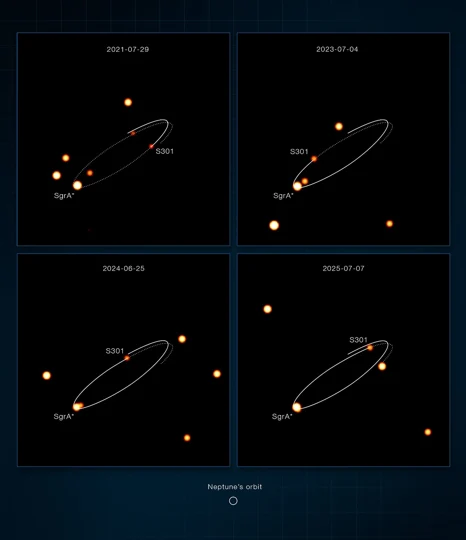
Observations with ESO’s Very Large Telescope Interferometer revealed S301, a star that reaches about 25,000 kilometres per second near the Milky Way’s central black hole. Its unusually tight orbit could let astronomers measure the black hole’s spin by tracking subtle changes in the star’s motion. That measurement has not yet been made.

Starward perspective

The key measurement will come from how the orbit changes over time. A record-setting speed is striking, but a sequence of precise positions is what can test the effect of the black hole’s spin.

Read the ESO release
VLT montage following S301’s orbit around Sagittarius A*.
S301 · ESO/GRAVITY collaboration

NSF NOIRLab

DESI imaging surveys release a map of nearly four billion objects

The DESI Legacy Imaging Surveys released a two-dimensional map covering about three-quarters of the sky and cataloguing nearly four billion objects. The public map combines observations from several imaging surveys. It gives researchers and the public a way to explore the same sky data and helps astronomers find targets such as strong gravitational lenses.

Read the NSF NOIRLab release

ESO

A faint third planet emerges in images of Beta Pictoris

Astronomers using ESO’s Very Large Telescope found Beta Pictoris d, a third planet around the young star Beta Pictoris. They confirmed it in archival images spanning more than a decade. The planet is about 100 times fainter than Beta Pictoris b, showing how old observations can help verify discoveries close to a bright star.

Read the ESO release

NSF NOIRLab

Rubin Observatory begins its ten-year sky survey

Rubin Observatory has begun the ten-year Legacy Survey of Space and Time, following commissioning and the start of its alert stream. The survey will revisit the southern sky every few nights. Comparing those images over time will let astronomers track moving Solar System objects and catch brief events such as stellar explosions.

Read the NSF NOIRLab release