Use Moon phase and altitude to plan two observing nights
Compare two evenings at the same place and time to decide which one suits a faint nebula and which one suits the Moon itself.
Decide what you want to see
A bright Moon can wash out the margins of a faint galaxy or nebula. It also gives you a target in its own right. Near first quarter, low sunlight along the boundary between lunar day and night casts long shadows that bring out relief. Near full Moon, try tracing the dark maria and bright rays that fan out from craters such as Tycho.
Check when the Moon is above the horizon
A new Moon is close to the Sun in the sky and usually sets close to sunset. A full Moon rises around sunset and stays up for much of the night. Those are useful starting points. At your actual observing time, check the Moon’s altitude, how far it is from your target, and whether the target itself clears buildings or terrain. If the Moon is well below the horizon, it cannot directly brighten the sky above your site.
Compare two evenings in Hong Kong
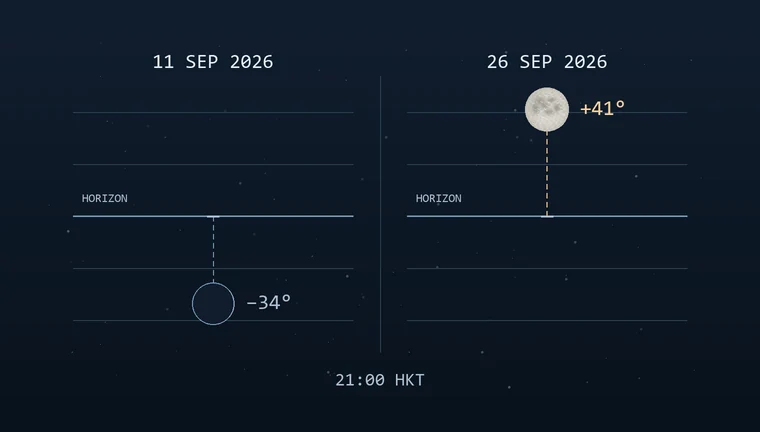
In Starward Observatory, open Telescope, select Earth and Hong Kong as the observing location, then enable Telescope mode. Use the observatory clock to enter 2026-09-26 13:00:00 with UTC selected. In Pointing, select Track a target and choose the Moon. The nearly full Moon should be about 41° above the horizon. Then change the clock to 2026-09-11 13:00:00 and check the Moon’s altitude again. It is near new Moon and roughly 34° below the horizon. Both times are 21:00 in Hong Kong.
Make a plan you can revise outdoors
Keep the two dates as rows in your notes. For each row, record the time, lunar phase, Moon altitude, target altitude and whether the target is close to the Moon. On site, add cloud, haze and nearby lights. Try the lower-moonlight window first for a faint target that is already high enough. Save the brighter evening for observing lunar markings or another object that tolerates a brighter sky.