Space updates
Discoveries, missions, and the observations behind them.
Latest updates
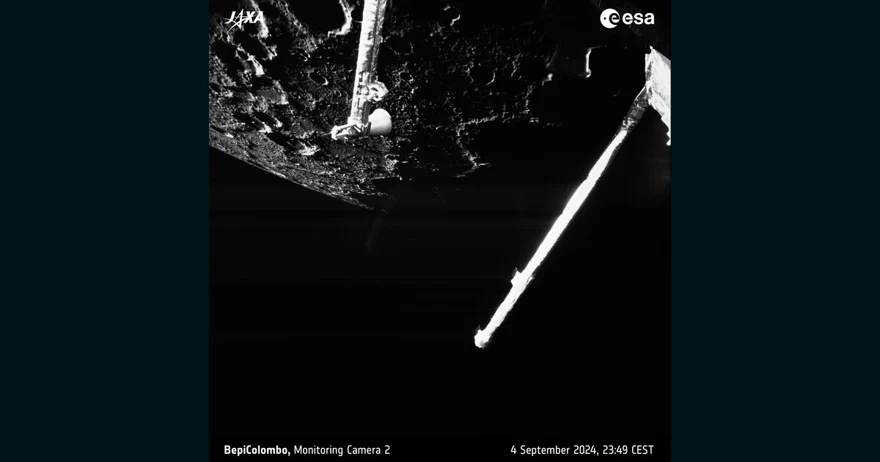
BepiColombo reaches Mercury orbit
ESA confirmed that the joint European–Japanese mission was captured into orbit around Mercury on 21 November. A software issue cut the engine burn short. The spacecraft is safe, and the flight team is investigating.
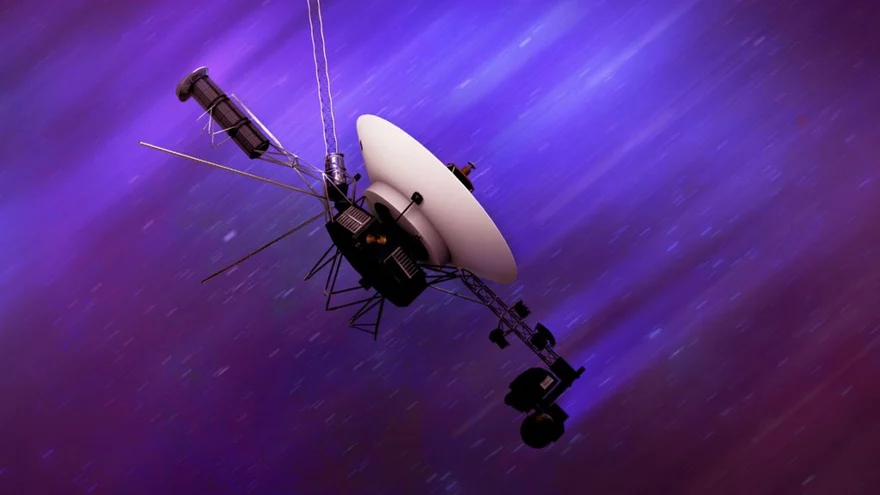
Voyager 1 reaches one light-day from Earth
Voyager 1 passed the milestone on 18 November, about 26 billion kilometres from Earth. A radio signal takes roughly 24 hours to travel each way, so a command and its reply take about two days in transit.
ESA selects a seven-spacecraft mission to study plasma
ESA member states have selected Plasma Observatory as the agency’s next medium-class science mission. Seven spacecraft will work together to measure particles and electromagnetic fields as the solar wind interacts with Earth’s magnetic environment. Taking measurements on several scales at once will help scientists follow how energy moves through that system.
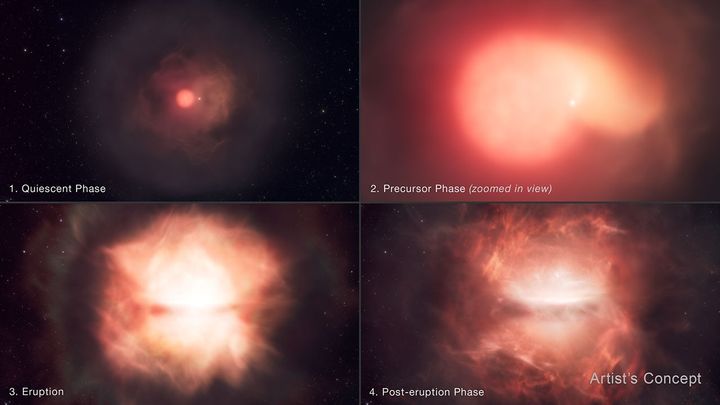
Webb helps trace a stellar merger in Andromeda
After a star spiralled into its supergiant companion, Webb observed the aftermath in infrared. Combined with earlier observations, the data let astronomers follow the system from before the 2025 eruption to the expanding dust left by the merger.
Stratospheric dust holds clues to ice beyond Neptune
Researchers examined 12 dust grains collected high above Earth. Minerals in the grains carry a signature consistent with ancient water rich in heavier oxygen isotopes, offering clues to the ice that once existed in the Kuiper Belt.
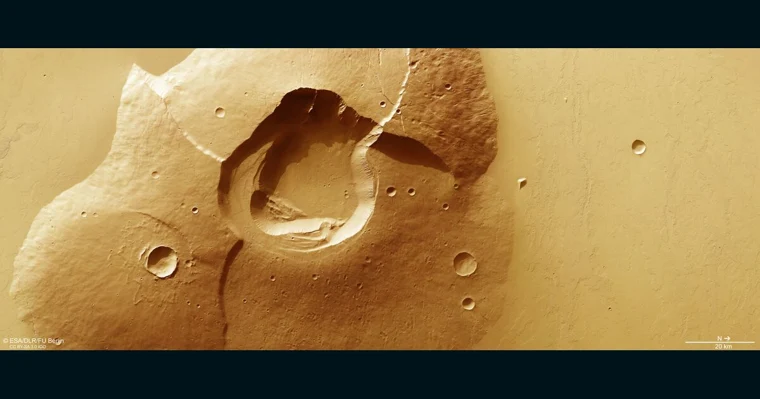
Mars Express images reveal two collapses at a Martian volcano
ESA’s Mars Express released a new view of Tharsis Tholus, an approximately eight-kilometre-high volcano on Mars. Images from its High Resolution Stereo Camera show an older outer caldera and a younger inner one. The nested depressions preserve evidence of at least two collapses, helping researchers piece together how the volcano’s summit changed over time.
Euclid releases the foundation for its 3D map
Euclid’s first major data release covers more than a billion objects and draws on about 13 months of observations. It gives researchers a starting point for charting the large-scale structure of the universe.
Two Chilean telescopes capture a nearby supernova brightening
The Dark Energy Camera and Gemini South imaged SN 2026ahvu while it was still brightening in the barred spiral galaxy NGC 1433. ATLAS first detected the object on 2 November, and spectroscopy identified it as a young Type Ia supernova. The new observations give astronomers a chance to study the early rise before peak brightness.