Star-hop from Orion’s Belt to M42
Use three bright stars and a short chain to find the Orion Nebula, then learn where to restart if you lose the trail.
Start with the Belt
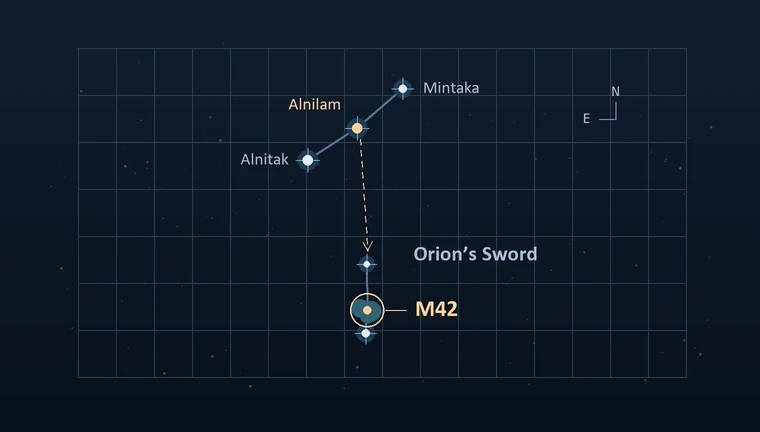
Find three bright, nearly evenly spaced stars in a short line. Viewed as a pattern, they run from Mintaka through Alnilam to Alnitak. The Belt can stand at a steep angle, so use its shape to recognise it. Take Alnilam, the middle star, as your starting point.
Use the Sword as a checkpoint
From Alnilam, look toward the half of Orion containing bright Rigel and Saiph. Move roughly four degrees, about one and a half Belt lengths, to a short chain of stars called the Sword. M42 lies in the middle part of that chain. With binoculars or a low-power eyepiece the nebula can look like a soft glow around a small group of stars. Focus on a nearby star first so that a blurred star is easy to rule out.

Rehearse the route on the chart
Open the Star-hop chart with M42 selected. If you open a fresh chart, search for M42 and choose the Orion Nebula. Zoom out until the Belt is visible. Select Alnilam and choose Use as starting star, then identify the Sword before you centre on M42 again. The chart shows the stars against one another. For a practice sky, set the observatory clock to 22:00 Hong Kong time (14:00 UTC) on 15 December 2026 from Hong Kong.
Recover from the last pattern you recognised
If the view looks unfamiliar, return to the Belt or the Sword and match the order and spacing of at least two stars before moving again. The chart has rotation and mirror controls to help match a finder or eyepiece. Under bright urban skies, an easy Belt and a clear Sword can still lead to a barely visible nebula. Try the same route from a darker site or after the Moon sets.