How do we know an exoplanet is real?
A repeating dip gives astronomers a testable prediction. A second measurement can help them work out what is making the light fade.
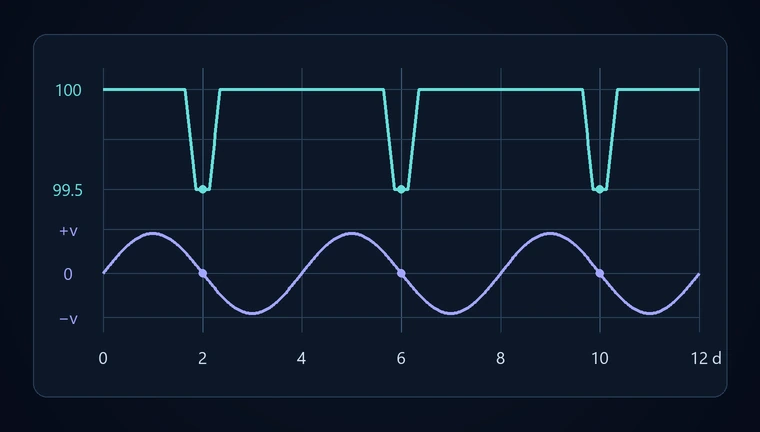
Start with what the telescope measures
A light curve records brightness over time. A dip that repeats at regular intervals is consistent with a planet crossing its star, and the interval suggests an orbital period. If the star is uniformly bright, the planet crosses fully inside the star's apparent disk and there is no light from other stars, the fraction of light lost is approximately the squared ratio of the planet's radius to the star's.
Look for the same dip from a different cause
A telescope may blend the light of a bright target with that of a fainter eclipsing pair of stars. A deep eclipse of the faint pair can make the combined light fall by as little as a planet would. This is one reason a promising signal may remain a candidate while astronomers gather evidence. Sharper images or careful measurement of where in the image the light fades can help locate the source. Alternating deep and shallow dips can also flag an eclipsing pair.
Put the star's motion on the same clock
Radial velocity measures motion along our line of sight through shifts in the star's spectral lines. An orbiting companion tugs the star, so its motion can repeat at the same period as the dips. Astronomers check whether both the timing and the size of the velocity signal fit a planetary orbit. The 1999 observations of HD 209458 found dips at times predicted from radial-velocity data. Where a planet's tug is too small to measure, other follow-up observations and statistical validation can show that plausible false positives are very unlikely.
Test two explanations on paper
For the synthetic example above, put brightness dips at days 2, 6 and 10 and set normal brightness to 100 units. If each dip bottoms out at 99.5, the trial period is four days and the missing light is 0.5%. A planet would have about 7.1% of the star's radius under the simple assumptions above, because the square root of 0.005 is about 0.071. Now give the target 99 units and an unresolved eclipsing pair one unit. If the pair loses half its light, the total is also 99.5. Plan one more measurement to distinguish the two cases. A sharper image taken during a dip could show whether the target or its neighbour actually dimmed.