What can a chart tell you when the time is uncertain?
Try a range of plausible times and record which chart details change along the way.
Start with the window you actually know
Write down the local date, place and time zone. If a record gives a one-hour window, use those bounds. If you know only the date, start at local midnight and sample through the end of that date. A noon chart gives you one possible set of positions. Label its time as an assumption when you save or compare it.
Recalculate a Hong Kong example five times
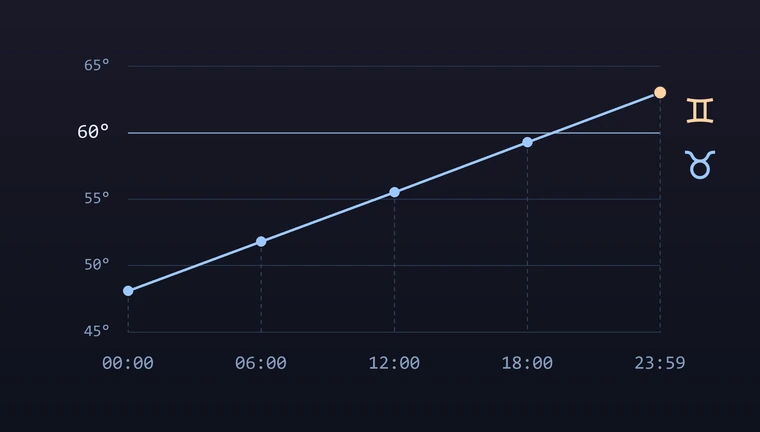
Open Tools → Astrology. For 2026-11-24 use Asia/Hong_Kong, latitude 22.3193, longitude 114.1694 and Whole sign. Start at 00:00, then try 06:00, 12:00, 18:00 and 23:59. Select Calculate chart each time. Copy the Moon and Saturn from Positions and angles. In a separate column, record the Ascendant above the body table and the first cusp under Houses.
Check the Moon against Saturn
The five Moon positions read about 18.10°, 21.81°, 25.53° and 29.27° Taurus, then 3.02° Gemini. On the full longitude scale, the sampled positions run from 48.10° to 63.02°, across the 60° sign boundary. Saturn stays near 8.2° Aries in all five samples. If the time of a boundary crossing matters, recalculate between the adjacent samples that straddle it. For the Moon in this exercise, narrow the interval between 18:00 and 23:59.
Track the local angles separately
The Ascendant is the point of the ecliptic rising at the local eastern horizon. As Earth rotates, the horizon sweeps through the chart’s zodiac, so the Ascendant can change considerably across a single local date. In the example it starts late in Leo, passes through Scorpio, Aquarius and Gemini at the intermediate samples, and ends early in Virgo. In Whole sign houses the first cusp is the start of the Ascendant’s sign. Open Houses and check how that boundary follows the sign.
Report what the sampling supports
Write ‘Moon in Taurus or Gemini within the sampled window’ and ‘Saturn near 8.2° Aries at every sampled time.’ Keep the Ascendant and house placements conditional on the time used. A few matching samples alone cannot rule out a crossing and return between them. If you find a reliable time record later, recalculate with the narrower window before using the time-sensitive placements in a symbolic reading.