How to calculate a conjunction or opposition
Take the shorter route around the zodiac, then check how far the result is from 0° or 180°.
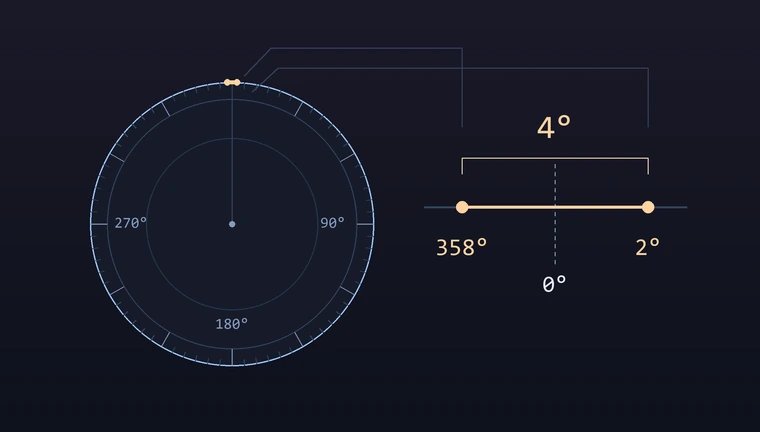
Put both positions on the same scale
In the chart’s Zodiac position column, each sign starts at 0°. Convert those sign-relative degrees to a single 0°–360° circle. Aries starts at 0°, Taurus at 30°, Gemini at 60°, and so on through Pisces at 330°. Add the displayed degrees to the start of the sign. For example, 28° Pisces becomes 358°, and 2° Aries stays 2°. In Starward Observatory you can also select a body to see its full ecliptic longitude.
Take the shorter arc
Subtract the two longitudes and take the absolute value. Then choose the smaller of that difference and 360° minus that difference. For 358° and 2°, the difference is 356° and the shorter arc is 4°. For 10° and 190°, both routes around the circle measure 180° and the points are exactly in opposition.
Compare the result with the exact aspect
A conjunction is exact at 0° and an opposition at 180°. The orb is the absolute difference between your result and the exact aspect angle. Starward Observatory includes natal conjunctions and oppositions up to 8° from exact, including the boundary. A separation of 4° gives a conjunction with an orb of 4°. A separation of 174° gives an opposition with an orb of 6°. Near a cutoff, compare using the full calculated precision when available. Subtracting displayed values can differ from the displayed orb by 0.01° because of rounding.
Try two pairs in the same chart
Open Tools → Astrology and enter 2026-11-24 12:00 in Asia/Hong_Kong, with latitude 22.3193 and longitude 114.1694. Choose Whole sign and select Calculate chart. Under Positions and angles, the Sun is at about 1.88° Sagittarius (241.88°) and the Moon at 25.53° Taurus (55.53°). Calculate the shorter arc and check Major aspects for their opposition, listed with an orb of 6.34°. Repeat for Mars and Jupiter, both in Leo. Their conjunction has an orb of 2.81°.
Keep longitude and sky separation distinct
Ecliptic longitude measures position along the zodiac. Ecliptic latitude measures how far a direction lies north or south of the ecliptic. Two hypothetical directions at the same longitude and at latitudes +3° and −3° have an exact longitude conjunction and sit 6° apart on the sky. To check whether one body can cover another, you need their apparent sky separation and sizes from the observer’s location. The astrological interpretation of an aspect belongs to a symbolic tradition.