Hera’s thermal camera brings Dimorphos out of shadow
Only a sliver of sunlight marked the 151-metre moonlet in reflected light. The thermal infrared image traced the whole body, including the terrain facing away from the Sun.
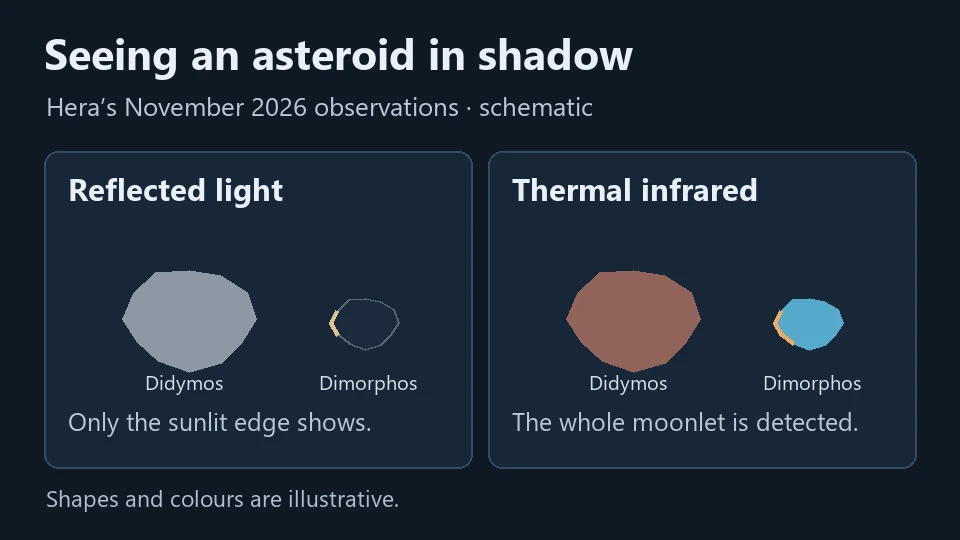
Hera’s Thermal Infrared Imager (TIRI), supplied and operated by JAXA, recorded Didymos and its smaller companion from 28.5 km away on 6 November 2026. The spacecraft also used a visible-light camera and a multispectral imager. ESA published the instrument comparison on 17 November, ahead of its scheduled close-up image release on 25 November. The spacecraft is examining the surface NASA’s DART mission struck in 2022. The earlier impact changed the moonlet’s orbit, and Hera’s new images will help investigate what happened to the body itself.
Starward perspective
Visible-light images show sunlight that bounces off the surface. TIRI records infrared radiation emitted by the surface itself, so a cold shadow can still be measured. Comparing how regions warm and cool over time will help test whether they are solid rock or loose rubble. The preview shows the reach of the instrument; identifying the material takes more evidence.