Webb finds clues to a star’s last hours in Cassiopeia A’s dust
Webb distinguished silica-rich and carbon-rich clumps in the supernova remnant Cassiopeia A. Their distribution, together with earlier X-ray evidence, supports a scenario in which layers inside the original star mixed shortly before it exploded.
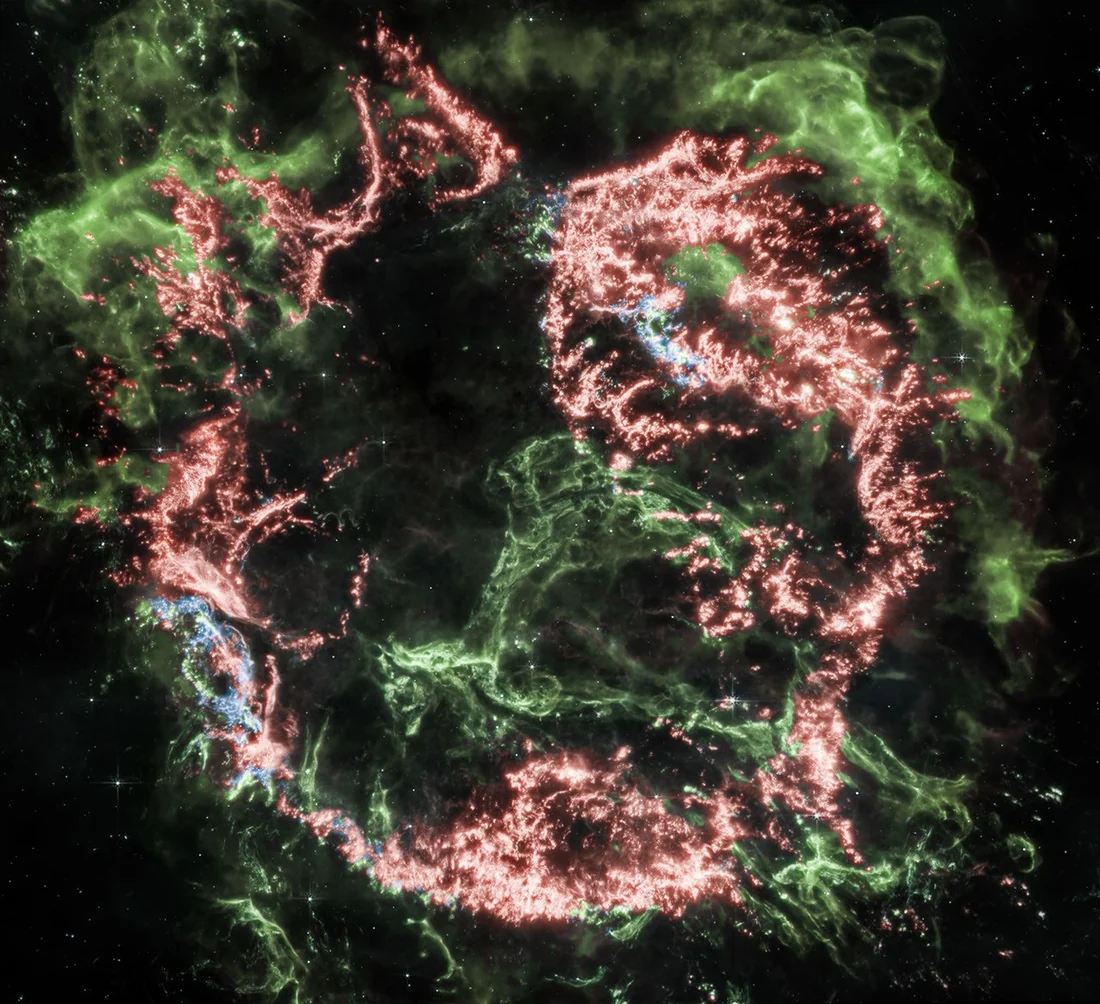
Earlier Spitzer observations helped the team pick three places to study with Webb’s Mid-Infrared Instrument. In debris heated by a shock moving back through the ejecta, two regions had different dominant kinds of dust. One was rich in silica and the other in carbon. A third region, nicknamed the Green Monster, contained complex magnesium silicates and is traced to material the star shed before it exploded. The team combined the dust map with data from Chandra and XRISM to infer that the star’s burning layers had begun to mix before the collapse.
Starward perspective
The distinction between material expelled before the explosion and dust formed in the debris matters because the two samples preserve different parts of the star’s history. The dust chemistry carries evidence of mixing. A timescale of hours before collapse comes from interpreting the combined observations and remains an estimate.