Why does Venus grow larger as it becomes a crescent?
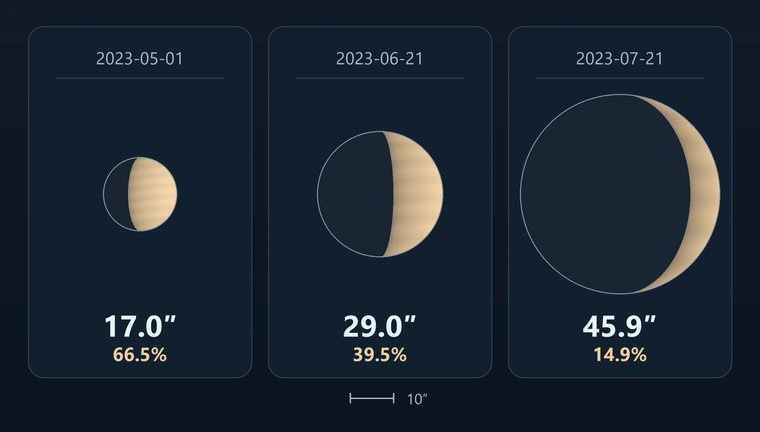
Follow Venus through three dates in 2023. As it approached Earth, its apparent disk grew to almost three times its earlier width while the illuminated portion narrowed to a crescent.
Follow Venus around the Sun
Venus orbits inside Earth’s orbit. When it is far from us near the far side of the Sun, we see much of its sunlit hemisphere and the disk looks small. As Venus comes round towards the space between Earth and the Sun, it gets closer and more of its night side faces us. The disk then spans a larger angle in the sky, with sunlight visible mainly along one edge. The planet’s physical diameter stays the same throughout.
Compare three dates on the same scale
NASA JPL’s Horizons ephemeris gives values as seen from Earth’s centre at 00:00 UTC on each date. On 1 May 2023 Venus was 17.0 arcseconds across and 66.5% illuminated. By 21 June it was 29.0 arcseconds across and 39.5% illuminated. On 21 July it reached 45.9 arcseconds and 14.9%. In the drawing, a 10-arcsecond scale bar means the same thing for all three disks. The outline marks the whole disk and the percentage measures how much of that disk is sunlit. The drawings align the lit edges for comparison. The crescent can tilt differently in the sky and through different optics.
Read the shape in Galileo’s sketches
In Galileo’s drawings, look for the contrast between the smaller, rounder views and the larger crescents. Seeing a gibbous Venus, with more than half the disk illuminated, contradicted the classic Ptolemaic arrangement, which kept Venus on the near side of the Sun. A Venus that goes around the Sun can show both shapes. NASA’s Astronomy Picture of the Day also published a telescopic sequence from the 2023 evening appearance, showing the growing disk and narrowing crescent in photographs.
Make a comparison with your own telescope
Pick two evenings several weeks apart during a single evening appearance. Check when Venus is above your western horizon after sunset. Wait until the Sun is fully below the horizon before using binoculars or a telescope to look for the planet. Use the same eyepiece or camera setup both times and keep each sketch or image at the same scale. Fit a circle to the curved outer limb to compare full diameters. Record the lit fraction separately, and note the date, local time and whether Venus was low enough for turbulence to blur the crescent.