How to read the two rings of a transit chart
Keep the birth chart fixed and move the transit date by a day. The Moon shows which positions belong to each moment.
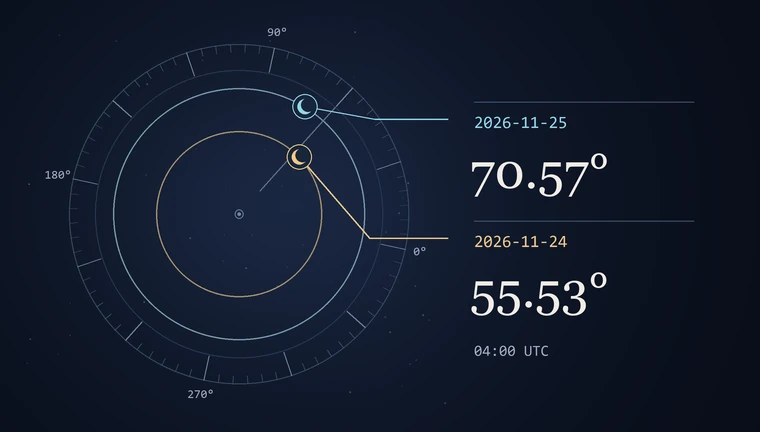
Read the date on each ring
In Starward Observatory’s Transits view, the inner ring holds the bodies from the birth chart. The outer ring shows the bodies at the UTC time you set for the transit. Both rings use the same geocentric tropical zodiac. The birth chart’s houses and angles stay fixed as you move the transit date. An aspect joining the rings compares an outer-ring body with an inner-ring body. The Major aspects section farther down still lists pairs from the birth chart.
Start both rings at the same instant
Open Tools → Astrology. Enter the sample birth time 2026-11-24 12:00 in Asia/Hong_Kong, with latitude 22.3193 and longitude 114.1694. Choose Whole sign and select Calculate chart. Open Transits, enter 2026-11-24 04:00 in Transit date and time (UTC), and leave the field to apply it. This is the same instant as the sample birth time. Both Moons are at about 25.53° Taurus (55.53° longitude). Select the outer Moon and find its conjunction with the natal Moon in Transit-to-natal aspects. The orb is 0.00° because the two positions coincide.
Advance the outer ring
Select Next day and check that Transit UTC now shows 2026-11-25 04:00. The outer Moon moves to about 10.57° Gemini (70.57° longitude). The inner Moon stays at 25.53° Taurus. The two positions are now about 15.04° apart, beyond the tool’s 8° conjunction limit, so the Moon-to-Moon row disappears. Other rows for the outer Moon can still be present. Read the natal body column to tell which pair each row describes.
Recognize an astronomical transit
An astronomer uses transit for an event such as a planet crossing the apparent disk of its star from a telescope’s viewpoint. The planet blocks some starlight while it crosses, producing a dip that a telescope can measure. A chart overlay compares calculated longitudes at two instants. Even if two longitudes match, an astronomical transit requires the bodies’ apparent disks to overlap along the observer’s line of sight at the same instant. Astrological meanings assigned to chart aspects belong to a symbolic tradition.