Why do Saturn’s rings seem to disappear?
Look down onto the rings and their bands spread out around Saturn. Move the same view towards the ring plane and those bands narrow to a fine line.
Look along an unusually thin ring
Saturn’s rings consist chiefly of icy particles mixed with rock and dust. The main rings spread far beyond the planet but are typically only about 10 metres thick vertically. Saturn’s equator, along which the rings lie, is tilted by about 27 degrees to its orbit. As Earth and Saturn orbit the Sun, we see the rings from different angles. When Earth crosses the plane of the rings, we briefly look along it and the familiar broad bands become hard to see.
Calculate how much an ellipse flattens
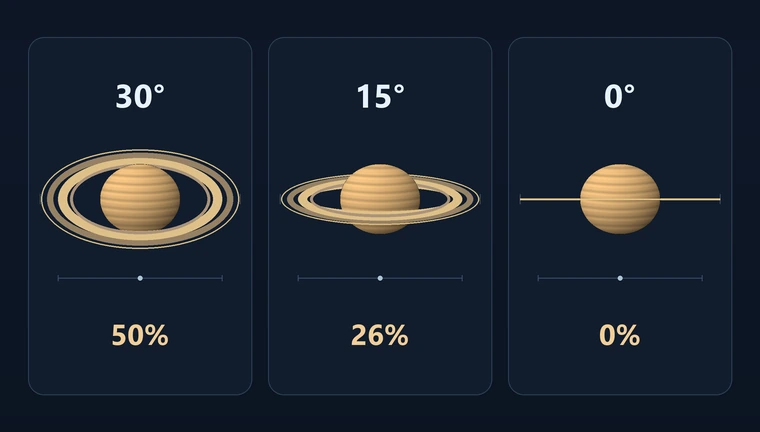
The opening angle measures how far your line of sight is above or below the ring plane. Imagine a thin circular ring seen from far away. Its projected height divided by its width is the sine of the opening angle, taken as a positive angle on either side. Make the outer edge 200 pixels wide in a sketch. At 30°, the ellipse is 100 pixels high. At 15°, it is about 52 pixels high. At 0°, an infinitely thin ring projects to a line. The drawing gives that line a stroke you can see. Real rings have thickness, and a telescope’s resolution and the image contrast affect whether you can pick them out.
Give Earth and the Sun separate angles
The Earth angle controls how much of the ring face we see. The Sun angle controls how sunlight falls on it. When Hubble observed Saturn near the Earth crossing on 22 May 1995, the Sun was still 2.7° above the ring plane. The photograph shows a dark band across Saturn where the rings cast a shadow. At Saturn’s equinox the Sun itself is in the ring plane. Cassini observed the rings from orbit around Saturn near the August 2009 equinox. Grazing sunlight made raised structures in the rings cast long shadows.
Test both angles on a table
Cut a ring from a sheet of card and hold it horizontally. Keep the card still and lower your eye from above it to the level of its edge. The opening narrows while the longest width stays about the same. Raise your eye again, then lower a desk lamp towards the plane of the card. The opening you see stays the same, but the shadow changes. The first move changes the viewing angle. The second changes the angle of illumination.