Use your latitude to find Polaris
Face true north and use your latitude to estimate how far to look up. Compare the view from Hong Kong and Tokyo, then watch the North Star move around the celestial pole.
Turn latitude into an angle above the horizon
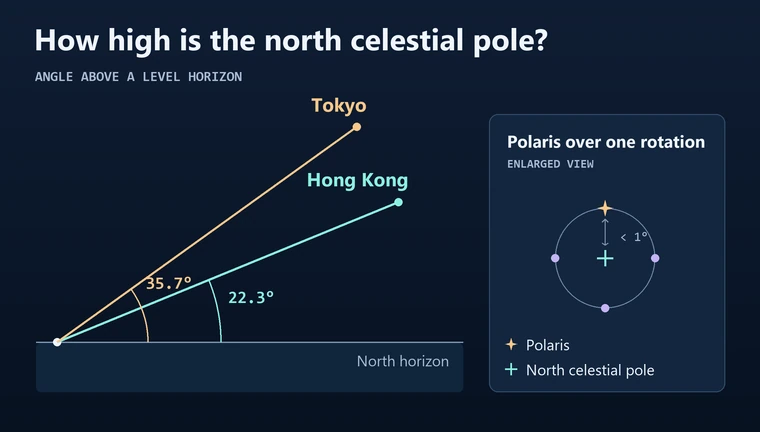
The north celestial pole is the point in the sky towards which Earth’s north rotation axis points. From the equator it lies on the north horizon, and from the North Pole it is overhead. At places in between, its angle above a level horizon equals the observer’s north latitude. Polaris lies close enough to the pole to serve as a practical marker. To find it, face true north and look up by roughly the number of degrees in your latitude.
Compare Hong Kong with Tokyo
At the Hong Kong Observatory’s latitude, about 22.3° N, the pole sits 22.3° above the north horizon. From Tokyo, Japan’s National Astronomical Observatory uses about 35.7° N for its sky chart, so the pole is 35.7° high there. Polaris sits roughly 13° higher from Tokyo. In Hong Kong, a building or ridge to the north can block it from a site with a good view of the rest of the sky. Check the skyline before settling on a spot.
Identify the star by the Big Dipper
When the Big Dipper is visible, find Merak and Dubhe, the two stars on the outside edge of its bowl. Follow the line from Merak through Dubhe for about five times their separation. It leads to Polaris at the end of the Little Dipper’s handle. Check that the star is roughly north and near your expected altitude. If you use a magnetic compass, allow for the local difference between magnetic and true north. Measure up from a level horizon or use a levelled angle-measuring tool if the skyline is uneven.
Watch the small circle around the pole
Polaris is currently less than 1° from the pole. As Earth rotates, the star traces a small circle about once every 23 hours 56 minutes, so its altitude and azimuth change slightly. To see the motion, keep a sky chart fixed on the north horizon and compare Polaris at intervals of about six hours. A narrow field centred on the pole makes the change easier to see. For a rough latitude estimate, one sighting is enough. For polar alignment, use the pole at the centre of the circle.