Why is the magnitude 5.7 galaxy M33 so hard to see?
The Triangulum Galaxy’s catalogue magnitude adds up light from across the whole galaxy. Compare it with Andromeda in the same sky to see how much the distribution of that light matters.
Read 5.7 as the total
NASA’s Hubble Messier catalogue gives M33 an apparent magnitude of 5.7. That integrated magnitude comes from adding the light across the galaxy. A magnitude 5.7 star concentrates roughly the same total light into a tiny spot in your view. M33 spreads it across a much larger patch of sky, so the added glow in any one part can be small. Under exceptionally dark, clear skies, some observers can pick it out with the unaided eye.
Spread the same light across four squares
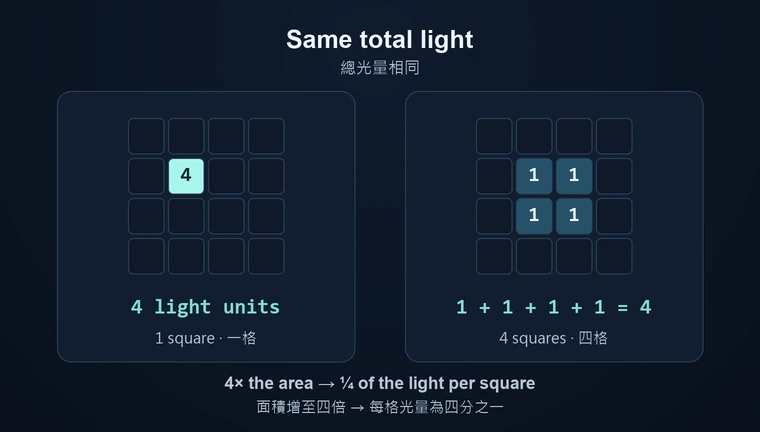
Imagine equal patches of sky as squares. Put four units of light in one square. Now spread those four units evenly across four squares. The total magnitude stays the same, while each lit square in the second view gets one quarter as much light as the first. Its surface brightness is therefore 2.5 × log₁₀(4), or about 1.5 magnitudes per square arcsecond fainter. Surface brightness describes light per unit of apparent area. Real galaxies have uneven light profiles, so the contrast of a bright core and that of a diffuse disk can differ in the same galaxy.
Look for Andromeda’s core first
In the same NASA catalogue M31, the Andromeda Galaxy, is magnitude 3.1. The 2.6-magnitude difference corresponds to about 11 times as much total light from M31. Both galaxies are extended, but M31 also has a bright central bulge that often shows up first. Check for an elongated glow around that core, then look for a subtle, diffuse brightening at M33’s position. If the sky itself is bright, the fainter outskirts of both can blend into it.
Keep both views comparable
Choose a clear, moonless night when both galaxies are high, preferably at similar altitudes and away from bright parts of the horizon. Around November is a good starting point in Hong Kong. Find Mirach (β Andromedae) on a chart and use it as a starting point. The two galaxies lie on opposite sides of it. Use the stars around each target to confirm the field. Allow about 30 minutes for dark adaptation and use the same binoculars or the same low-power eyepiece for both. Try looking slightly to the side of each target while keeping the instrument still. Compare the view of M31, then M33, then M31 again within the same session.
Record what actually appeared
For each galaxy, note the time, altitude, instrument, haze or skyglow, and whether you saw a core, an extended glow, or only the field stars. A confirmed field with no trace of M33 is a result. If you repeat the pair under darker skies, compare each galaxy with your earlier notes. Changes in the visibility of the diffuse glow tell you about the contrast of the galaxy against the sky.