How does a lunar crater look from first quarter to full Moon?
Watch Copernicus come into sunlight after first quarter, then find it again near full Moon. Shadows first reveal its shape. Later, bright rays help you trace where material from the impact landed.
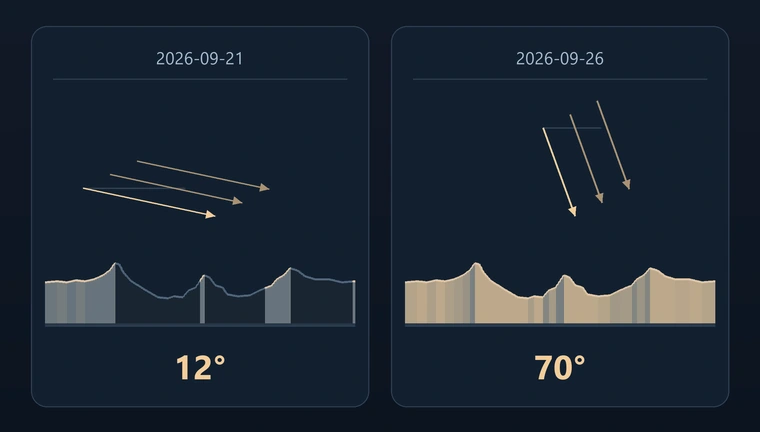
Use the terminator to find long shadows
The terminator is the boundary between day and night on the Moon. On its sunlit side, the Sun is low over the local horizon, so crater rims and peaks cast long shadows. The drawing uses the same simplified crater in both panels, with sunlight 12° or 70° above the horizontal. Measured from the local vertical, these are incidence angles of 78° and 20°. A high incidence angle means grazing light. As the Sun climbs, shadows contract and relief becomes harder to read. Even at full Moon, the Sun can still be low over features close to the limb.
See what is lit at first quarter
Open NASA’s 2026 Dial-A-Moon at 19 September 00:00 UTC, about three hours after first quarter. The crater Albategnius lies just on the bright side of the terminator, below the disk’s centre, with the Sun about 5° above its local horizon. Compare its shadowed interior with the view on 26 September at 13:00 UTC, near full Moon, when the Sun there is about 78° high. At the same first-quarter time, the centre of Copernicus is still on the night side. A phase tells you how much of the whole disk is lit. To time one crater, check when the terminator passes it.
Follow Copernicus from sunrise to high Sun
In Dial-A-Moon, set 21 September 2026 at 13:00 UTC. Look for Copernicus just northwest of the disk’s centre in a north-up view. The Moon is waxing gibbous and the Sun is about 12° above the crater’s local horizon. Look for the shadow inside its rim. Then set 26 September at 13:00 UTC. The local Sun is about 70° high and the rays around Copernicus stand out against the dark surroundings. To calculate each elevation, take 90° minus the angular distance on the lunar globe from the crater’s centre to NASA’s subsolar point. Local slopes and the crater walls affect the actual shadows.
Check the terrain in spacecraft images
NASA’s Lunar Orbiter mosaic of Copernicus shows rugged walls and central peaks standing above the crater floor. The high-Sun Lunar Reconnaissance Orbiter image shows a different clue, a small patch of reflective debris from the same impact. The arrows in that close-up point to bright streaks extending away from Copernicus. From Earth, the individual streaks in the close-up are too fine to resolve, but the wider system of bright rays is visible.
Repeat the comparison at the eyepiece
Use a lunar atlas or a simulation to choose a night when your crater is just inside the sunlit edge. Check that the Moon is above obstructions at your site, then find the crater at low power before increasing magnification. Sketch the shadowed side of the rim and any central peak you can see. Return near full Moon with the same eyepiece and sketch the bright rays and nearby dark plains. Align both sketches using neighbouring features, since the view can rotate or mirror through different optics.