Why can’t Voyager 1 answer right away?
At one light-day from Earth, a command takes a day to reach Voyager 1. Even an immediate reply takes another day to get back.
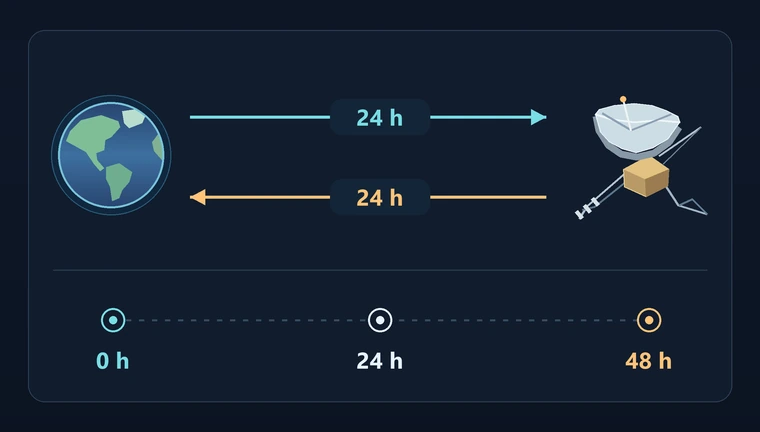
Turn a day into a distance
A light-day is the distance light travels through a vacuum in 24 hours. A radio signal travels at the same speed as light in a vacuum, about 299,792 kilometres per second. Multiply by 86,400 seconds and you get about 25.9 billion kilometres. NASA reported that Voyager 1 reached about this distance from Earth on 18 November 2026. The distance changes as Earth and the probe move, so use one light-day as a fixed value for the diagram and exercise.
Put the command and reply on a clock
Imagine Earth sends a command at 09:00 UTC on Monday. At the fixed distance in the diagram it reaches Voyager at 09:00 on Tuesday. With an immediate reply, Earth starts receiving it at 09:00 on Wednesday. Now give Voyager 20 minutes to run the command before it starts replying. What time does the reply start arriving? Add the extra 20 minutes once, at Voyager, to get 09:20 on Wednesday. The earliest arrival in this second example is 48 hours and 20 minutes after the command was sent.
Time the message separately
Suppose the reply contains 12,000 bits. At an illustrative 160 bits per second, transmitting the full reply takes 75 seconds. Doubling the rate to 320 bits per second cuts that duration to 37.5 seconds. In both cases the reply’s first bit still travels for about 24 hours. The time a team needs to read a complete reply also depends on when a ground antenna can listen and how long it takes to decode the data.
Follow the wait in a real repair
In April 2024, Voyager 1 was sending unreadable data because a memory chip in its flight data computer had failed. Engineers sent instructions on 18 April to put the code that packages engineering data in working memory. NASA put the light travel time then at about 22.5 hours each way, or about 45 hours for the round trip. On 20 April the reply showed the change had worked. A follow-up command would take another round trip to check, so the team had to plan the repair around the wait between steps.