Track Jupiter’s moons over three nights
Draw Jupiter in the same place on three successive dates. A close pair of moons on the second night shows why a record of positions tells you more than a count.
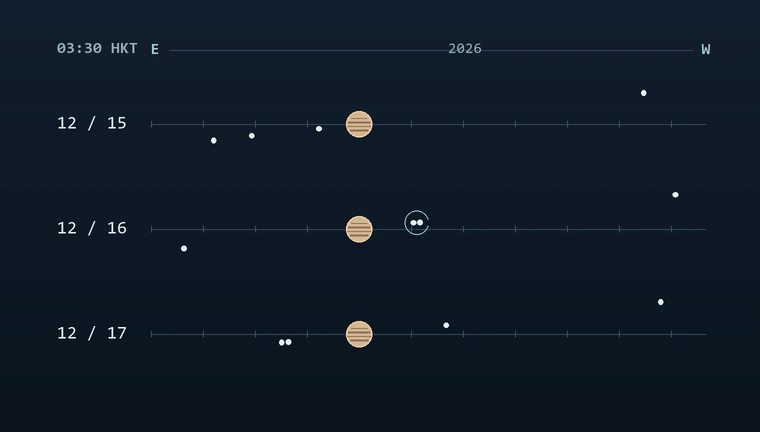
Give every sketch the same ruler
Centre Jupiter and use the width of its disk as one unit. Draw a point for each light you can distinguish and estimate how many Jupiter diameters it lies from the centre. Keep the sides consistent. If you can safely pause tracking, the direction Jupiter drifts relative to the field marks celestial west. Mark that side on the sketch and repeat the check if you move the camera or change the optical setup. A low-power view is a good starting point because an outer moon can sit far from the planet.
Preview the same local time on three dates
Open Telescope in Starward Observatory, select Earth and Hong Kong as the observing location, and enable Telescope mode. In Pointing, search for Jupiter under Tracking target and select it. In the observatory clock, choose UTC and enter 2026-12-14 19:30:00, then repeat for 15 and 16 December at 19:30 UTC. Those are 03:30 on 15, 16 and 17 December in Hong Kong. Jupiter is about 70° above the horizon in all three rehearsals. On site, record the actual time and time zone so you can compare the sketch against the right ephemeris.
Follow a point that changes sides
In the model sketch, the farthest point to the west is Callisto on all three dates. Io is about 1.6 Jupiter diameters east on the first date, 2.3 diameters west on the second and 2.7 diameters east on the third. On the second date Europa lies about 2.1 diameters west, close enough that you may draw a single point depending on the equipment and conditions. In the illustration, ticks are two Jupiter diameters apart. Vertical offsets are compressed and the moon symbols are enlarged. Check your own sketch before you use a prediction to name the points.
Log what the optics let you separate
Write down your site, instrument, magnification and how steady Jupiter’s edge looked. Use a note such as ‘one point west near two diameters, possibly two’ if you could not split a pair. A moon can also cross Jupiter’s face, pass behind the disk or enter the planet’s shadow. With three sketches, look for points that stay near Jupiter but repeatedly change their relative offsets. A background star can move across a Jupiter-centred field as the planet moves, so use the changing arrangement of several points as your evidence.