The 2026 Geminids in Hong Kong
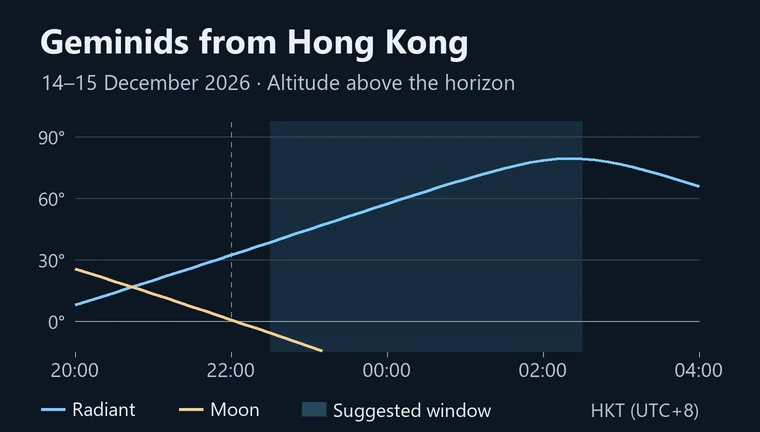
The predicted peak is at 22:00 on 14 December in Hong Kong. The Moon sets shortly afterwards as the radiant climbs, opening a useful viewing window through the early hours.
Why the hours after the peak still work
The International Meteor Organization predicts a broad maximum centred on 14 December 2026 at 14:00 UTC, which is 22:00 Hong Kong time. In our model at 22.32° N, 114.17° E, the radiant is then about 32° above the east-northeastern horizon. The waxing crescent Moon is about one-quarter illuminated and sets around 22:07 on a level horizon. From 22:30 to about 02:30 the Moon is down and the radiant climbs much higher. The site's model suggests 01:40 as one particularly good time, when the radiant is about 76° high. The window extends past midnight into 15 December. The time of peak activity is a prediction, and a particular street, ridge or cloud bank can change the view.
Find Gemini, then look across a broad patch of sky
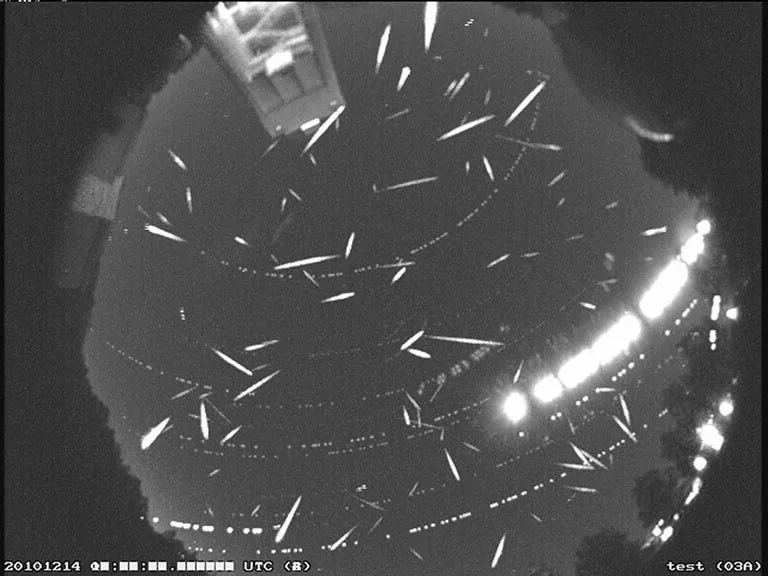
The radiant is near Castor, one of the two bright stars at the head of Gemini. At 22:00 face east-northeast and look about three fist-widths above a level horizon. Use that direction to get your bearings. Then watch a broad, dark patch well away from the radiant where the meteor tracks are easier to see as long streaks. A Geminid's track, extended backwards, leads toward the radiant. The geometry is like parallel railway tracks appearing to meet in the distance. Earth's passage through the debris stream associated with asteroid 3200 Phaethon produces those streaks.
Watch with your eyes and keep a count you can compare
Choose a clear site with a wide view and shield your eyes from nearby lamps. Give them about half an hour to adapt before counting, and use your eyes for the widest field. In a 30-minute block, record the time, cloud cover, and how many tracks point back toward Gemini. Keep other meteors or uncertain tracks in a separate tally. Repeat from the same spot after midnight. The often-quoted ZHR of 150 is a standardised peak rate for a dark sky and a radiant at the zenith. Your count reflects the sky you actually saw, including the effect of light pollution, changing radiant height, and the part of the sky you watched.
Rehearse the window in Starward
Open Observing, switch to Meteor showers, choose Geminids and set the observing date to 14 December 2026. Use Hong Kong as the site or enter 22.3193° N, 114.1694° E to reproduce this example. Set the time zone to Asia/Hong_Kong and calculate. Compare the local peak and the suggested window. The wide telescope preview can show the radiant and the surrounding sky. Take the clock and the direction into the field, then judge cloud and nearby lights on the night.